
Other places · Central Scotland
Dál Riata
Also known as: Dál Riada, Dail Riata
In or near Kilmartin.
Dál Riata in Scotland Islands, United Kingdom.

David Hawgood — CC BY-SA 2.0 via Wikimedia Commons licence

Plan your visit
- Typical visit
- 1 h–2 h
- Family-friendly
About
Dál Riata is a place of interest in Scotland Islands, United Kingdom — drawn from open-data sources for visitor reference. See the linked Wikipedia article for the full description.
Photo gallery
From the Wikipedia article
Dál Riata or Dál Riada (also Dalriada) () was a Gaelic kingdom that encompassed the western seaboard of Scotland and north-eastern Ireland, on each side of the North Channel. At its height in the 6th and 7th centuries, it covered what is now Argyll ("Coast of the Gaels") in Scotland and part of County Antrim in Northern Ireland. After a period of expansion, Dál Riata eventually became associated with the Gaelic Kingdom of Alba. In Argyll, it consisted of four main kindreds or tribes, each with their own chief: the Cenél nGabráin (based in Kintyre), the Cenél nÓengusa (based on Islay), the Cenél Loairn (who gave their name to the district of Lorn) and the Cenél Comgaill (who gave their name to Cowal). The hillfort of Dunadd is believed to have been its capital. Other royal forts included Dunollie, Dunaverty and Dunseverick. Within Dál Riata was the important monastery of Iona, which played a key role in the spread of Celtic Christianity throughout northern Britain, and in the development of insular art. Iona was a centre of learning and produced many important manuscripts. Dál Riata had a strong seafaring culture and a large naval fleet. Dál Riata is said to have been founded by the legendary king Fergus Mór (Fergus the Great) in the 5th century. The kingdom reached its height under Áedán mac Gabráin (r. 574–608). During his reign Dál Riata's power and influence grew; it carried out naval expeditions to Orkney and the Isle of Man, and assaults on the Brittonic kingdom of Strathclyde and Anglian kingdom of Bernicia. However, King Æthelfrith of Bernicia checked its growth at the Battle of Degsastan in 603. Serious defeats in Ireland and Scotland during the reign of Domnall Brecc (died 642) ended Dál Riata's "golden age", and the kingdom became a client of Northumbria for a time. In the 730s the Pictish king Óengus I led campaigns against Dál Riata and brought it under Pictish overlordship by 741. There is disagreement over the fate of the kingdom from the late 8th…
Excerpt from Wikipedia under CC BY-SA 4.0. See the source article linked in Sources below.
Background
History
The 11th-century Duan Albanach (Song of the Scots) tells that the three sons of Erc—Fergus Mór, Loarn and Óengus—conquered Alba (Scotland) in around 500. The 8th-century writer Bede offers another, and probably older, account wherein Dál Riata was conquered by Irish Gaels led by a certain Reuda. Old Irish dál means 'portion' or 'share', and is usually followed by the name of an eponymous founder. Bede's tale may come from the same root as the Irish tales of Cairpre Riata and his brothers, the Síl Conairi (sons/descendants of Conaire Cóem and Conaire Mór). The story of Dál Riata moves from foundation myth to something nearer to history with the reports of the death of Comgall mac Domangairt…
Description
Áed Find may appear in 768, fighting against the Pictish king of Fortriu. At his death in 778, Áed Find is called "king of Dál Riata", as is his brother Fergus mac Echdach in 781. The Annals of Ulster say that a certain Donncoirche, "king of Dál Riata" died in 792, and there the record ends. Any number of theories have been advanced to fill the missing generations, none of which are founded on any very solid evidence. A number of kings are named in the Duan Albanach, and in royal genealogies, but these are rather less reliable than we might wish. The obvious conclusion is that whoever ruled the petty kingdom of Dál Riata after its defeat and conquest in the 730s, only Áed Find and his…
Sourced from Wikipedia under CC BY-SA 4.0.
- Coordinates
- 56.0861, -5.4783
- District
- Argyll and Bute
- Postcode
- PA31 8SU
- Parliamentary constituency
- Argyll, Bute and South Lochaber
- Established
- 498
Sources
Other places nearby

Dunadd Fort
Forts · 0.0 km

Dunadd
Mountains & hills · 0.0 km
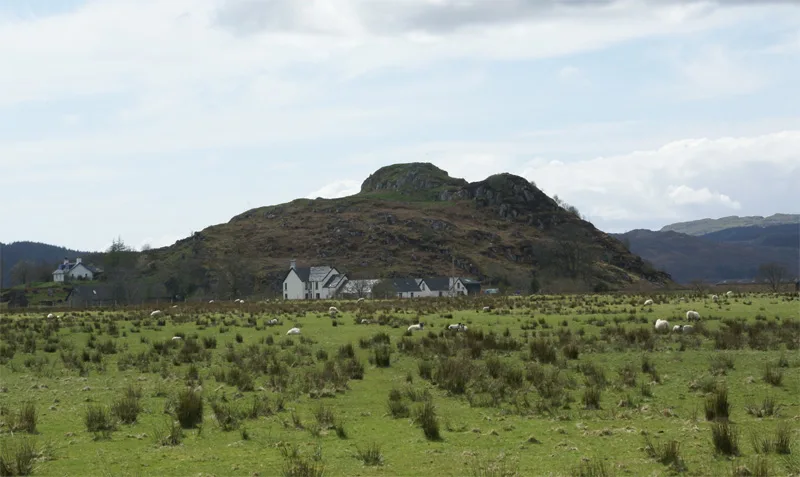
Dunadd
Hill forts · 0.1 km

Dunadd, standing stone 190m ESE of Dunadd Cottage
Windmills · 0.3 km

Baile Mor, dun site
Archaeological sites · 0.8 km

Bàrr an Fhithich
Mountains & hills · 1.0 km

Dunamuck,one fallen & two standing stones
Windmills · 1.2 km

Moine Mhòr
Wildlife reserves · 1.5 km

Dunamuck, two standing stones
Windmills · 1.6 km
cairn and two standing stones 460m ENE of Dunamuck
Windmills · 1.7 km

Fiadhach Barr
Mountains & hills · 1.7 km

Creagan Breac
Mountains & hills · 1.8 km
Nearby
📷 3📷 5Mountains & hills · Central Scotland
Dunadd
Dunadd — mountain in scotland highlands. Elevation: 55 m.
📷 5📷 5Windmills · Central Scotland
Dunadd, standing stone 190m ESE of Dunadd Cottage
Dunadd, standing stone 190m ESE of Dunadd Cottage — a post mill in scotland-highlands, United Kingdom.
📷 3Archaeological sites · Central Scotland
Baile Mor, dun site
Baile Mor, dun site — a archaeological in scotland-highlands, United Kingdom.
📷 5Mountains & hills · Central Scotland
Bàrr an Fhithich
Bàrr an Fhithich — mountain in scotland highlands. Elevation: 57 m.
Where to eat & stay near Dál Riata
Places to stay
 📷 5
📷 5 📷 5
📷 5Campsites · Central Scotland
Lochgilphead Caravan Park
Lochgilphead Caravan Park — a campsite in scotland highlands.
 📷 5
📷 5Caravan parks · Central Scotland
Ardfern Motorhome Park
Ardfern Motorhome Park — a caravan park in scotland highlands.
 📷 5
📷 5Campsites · Central Scotland
Leachive Caravan Park
Leachive Caravan Park — a campsite in scotland highlands.
 📷 5
📷 5Hotels · Central Scotland
Loch Melfort Hotel
Loch Melfort Hotel — a hotel in scotland highlands.
 📷 5
📷 5Campsites · Central Scotland
Glendaruel Caravan & Camping Park
Glendaruel Caravan & Camping Park — a campsite in scotland highlands.
Places to eat & drink
 📷 7
📷 7Historic pubs · Central Scotland
Cairnbaan Hotel, Crinan Canal
Cairnbaan Hotel, Crinan Canal in Scotland Central, United Kingdom.
More places in this region
 📷 3
📷 3 📷 3
📷 3 📷 5
📷 5 📷 5
📷 5Frequently asked questions
- Where is Dál Riata?
- Dál Riata is in the Scottish Highlands, United Kingdom (postcode PA31 8SU).
- What is Dál Riata?
- Dál Riata in Scotland Islands, United Kingdom.
- How do I get to Dál Riata?
- Drivers can use postcode PA31 8SU.
- When was Dál Riata built?
- Built or established in 498.
- How do I get to Dál Riata?
- Drivers can navigate to postcode PA31 8SU. It sits within the Argyll, Bute and South Lochaber parliamentary constituency.