
Public art & sculpture · East Midlands
George Boole
In or near Lincoln.
George Boole — a public art in East Midlands, United Kingdom.

Graham Robson — CC BY-SA 2.0 via Wikimedia Commons licence

Plan your visit
- Typical visit
- 1 h–2 h
- Nearest railway station
- Lincoln · 0.1 km
- Free entry
- Dog-friendly
Getting there & planning your visit
To visit the George Boole public art installation, you can take a train to Lincoln station, which is just 0.1 km away. Entry to the installation is free, and it is accessible for all visitors.
About
George Boole is a public art located in East Midlands, United Kingdom. Sourced from OpenStreetMap (ODbL licence); see local listings for visitor information, opening hours and admission details.
Photo gallery
From the Wikipedia article
George Boole ( BOOL; 2 November 1815 – 8 December 1864) was an English autodidact, mathematician, philosopher and logician who served as the first professor of mathematics at Queen's College, Cork in Ireland. He worked in the fields of differential equations and algebraic logic, and is best known as the author of The Laws of Thought (1854), which contains Boolean algebra. Boolean logic, essential to computer programming, is credited with helping to lay the foundations for the Information Age. Boole was the son of a shoemaker. He received a primary school education and learned Latin and modern languages through various means. At 16, he began teaching to support his family. He established his own school at 19 and later ran a boarding school in Lincoln. Boole was an active member of local societies and collaborated with fellow mathematicians. In 1849, he was appointed the first professor of mathematics at Queen's College, Cork (now University College Cork) in Ireland, where he met his future wife, Mary Everest. He continued his involvement in social causes and maintained connections with Lincoln. In 1864, Boole died due to fever-induced pleural effusion after developing pneumonia. Boole published around 50 articles and several separate publications in his lifetime. Some of his key works include a paper on early invariant theory and "The Mathematical Analysis of Logic", which introduced symbolic logic. Boole also wrote two systematic treatises: "Treatise on Differential Equations" and "Treatise on the Calculus of Finite Differences". He contributed to the theory of linear differential equations and the study of the sum of residues of a rational function. In 1847, Boole developed Boolean algebra, a fundamental concept in binary logic, which laid the groundwork for the algebra of logic tradition and forms the foundation of digital circuit design and modern computer science. Boole also attempted to discover a general method in probabilities, focusing on determining the consequent probability of events logically connected to given probabilities. Boole's work was expanded upon by various scholars, such as Charles Sanders Peirce and William Stanley Jevons. Boole's ideas later gained practical applications when Claude Shannon and Victor Shestakov employed Boolean algebra to optimize the design of electromechanical relay systems, leading to the development of modern electronic digital computers. His contributions to mathematics earned him various honours, including the Royal Society's first gold prize for mathematics, the Keith Medal, and honorary degrees from the Universities of Dublin and Oxford. University College Cork celebrated the 200th anniversary of Boole's birth in 2015, highlighting his significant impact on the digital age.
Excerpt from Wikipedia under CC BY-SA 4.0. See the source article linked in Sources below.
- Coordinates
- 53.2265, -0.5392
- County
- Lincolnshire
- District
- Lincoln
- Parish
- Lincoln, unparished area
- Postcode
- LN5 7EW
- Parliamentary constituency
- Lincoln
- Nearest railway station
- Lincoln — 0.1 km
Sources
- osm: node/12119328472 (ODbL)
- wikipedia: George Boole (CC BY-SA 4.0)
Other places nearby

Lincoln Central railway station
Heritage railway stations · 0.1 km

Everyman
Cinemas · 0.1 km
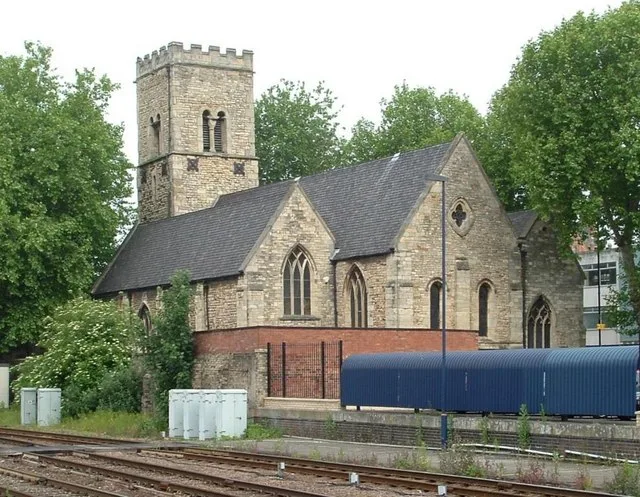
St. Mary le Wigford’s Church, Lincoln
Historic churches · 0.1 km

Market Building
Gardens · 0.1 km

Whitefriars, 333 High Street, Lincoln
Gardens · 0.2 km

St. Andrew's Church, Lincoln
Historic churches · 0.2 km

Thorngate
Literary houses · 0.2 km
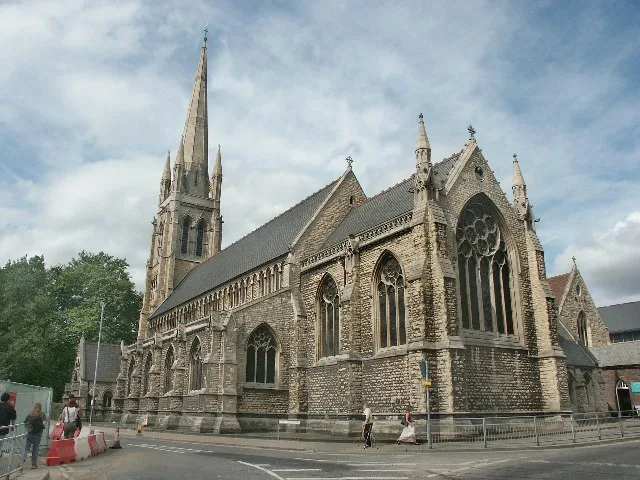
St. Swithin's Church, Lincoln
Historic churches · 0.2 km

Empowerment (sculpture)
Public art & sculpture · 0.2 km
Empowerment
Public art & sculpture · 0.2 km
Lincoln, England
Museums · 0.2 km

War Memorial 5 Metres East of Church of St Benedict
Memorials & monuments · 0.2 km
Nearby
📷 4Heritage railway stations · East Midlands
Lincoln Central railway station
Lincoln Central railway station — a Grade II-listed railway station in england-east-midlands, United Kingdom.
📷 5📷 5Historic churches · East Midlands
St. Mary le Wigford’s Church, Lincoln
St. Mary le Wigford’s Church, Lincoln — Grade I listed church in Lincoln, Lincolnshire, England, UK.
📷 4Gardens · East Midlands
Market Building
Market Building — a garden in england-east-midlands, United Kingdom.
📷 4Gardens · East Midlands
Whitefriars, 333 High Street, Lincoln
Whitefriars, 333 High Street, Lincoln — a garden in england-east-midlands, United Kingdom.
📷 3Historic churches · East Midlands
St. Andrew's Church, Lincoln
St. Andrew's Church, Lincoln — church in United Kingdom.
Where to eat & stay near George Boole
Places to stay
 📷 5
📷 5 📷 5
📷 5 📷 7
📷 7Hotels · East Midlands
DoubleTree by Hilton Lincoln
DoubleTree by Hilton Lincoln — a hotel in england east midlands. 4-star. Brand: DoubleTree.
 📷 5
📷 5Hotels · East Midlands
The Old Palace Lodge
The Old Palace Lodge — a hotel in england east midlands.
 📷 5
📷 5B&Bs · East Midlands
Cathedral View Guest House
Cathedral View Guest House — a bed-and-breakfast in england east midlands.
Hostels · East Midlands
Lincoln Digs
Lincoln Digs — a hostel in england east midlands.
Places to eat & drink
 📷 5
📷 5Cafés · East Midlands
Little Lincoln Cafe
Little Lincoln Cafe — a café in england east midlands.
 📷 5
📷 5Cafés · East Midlands
Madame Waffle
Madame Waffle — a café in england east midlands.
 📷 5
📷 5Historic pubs · East Midlands
268, High Street
268, High Street in England East Midlands, United Kingdom.
 📷 5
📷 5Restaurants · East Midlands
Cafe Zoot
Cafe Zoot — a restaurant in england east midlands.
 📷 5📷 7
More places in this region
 📷 5
📷 5Public art & sculpture · East Midlands
West Walton Village Sign
West Walton Village Sign — a public art in East Midlands, United Kingdom.
 📷 5
📷 5Public art & sculpture · East Midlands
Tilney St Lawrence Village Sign
Tilney St Lawrence Village Sign — a public art in East Midlands, United Kingdom.
 📷 5
📷 5Public art & sculpture · East Midlands
Emneth Village Sign
Emneth Village Sign — a public art in East Midlands, United Kingdom.
 📷 5
📷 5Public art & sculpture · East Midlands
Marshland St James Village Sign
Marshland St James Village Sign — a public art in East Midlands, United Kingdom.
Frequently asked questions
- Where is George Boole?
- George Boole is in Lincolnshire, the East Midlands, United Kingdom (postcode LN5 7EW), in the parish of Lincoln, unparished area.
- What is George Boole?
- George Boole — a public art in East Midlands, United Kingdom.
- How do I get to George Boole?
- The nearest railway station is Lincoln, about 0.1 km away. The nearest town is Lincoln. Drivers can use postcode LN5 7EW.
- Is George Boole free to visit?
- Yes, George Boole is free to enter.
- How do I get to George Boole?
- The nearest railway station is Lincoln, about 0.1 km away. Drivers can navigate to postcode LN5 7EW.