
Public art & sculpture · Central Scotland
Equestrian statue of Charles II
In or near Edinburgh.
Equestrian statue of Charles II in Scotland Central, United Kingdom.

kim traynor — CC BY-SA 2.0 via Wikimedia Commons licence

Plan your visit
- Typical visit
- 1 h–2 h
- Nearest railway station
- Edinburgh Waverley · 0.3 km
- Free entry
- Family-friendly
- Dog-friendly
- Wheelchair accessible
Getting there & planning your visit
The Equestrian statue of Charles II is located in central Edinburgh, postcode EH1 1RE, and is accessible via the nearest railway station, Edinburgh Waverley, which is 0.3 km away. Entry to the statue is free, and it is wheelchair accessible.
About
Equestrian statue of Charles II is a public sculpture in Scotland Central, United Kingdom, dating from 1685. Britain's public art ranges from Henry Moore reclining figures and Anthony Gormley installations to the Angel of the North and the surviving statues of empire.
Photo gallery
Official information
St Giles’ Cathedral, founded in 1124, is an active church and a significant historical site in Edinburgh. Visitors can explore its rich history, art, and music while participating in worship or quiet reflection.
From the Wikipedia article
An equestrian statue of Charles II trampling Cromwell stands near Newby Hall in North Yorkshire, England. It was previously sited at Gautby Hall in Lincolnshire, and was originally installed at the Stocks Market in the City of London. It is a Grade II listed building. The 17th-century statue is made of Carrara marble. It shows a man with the features of King Charles II in armour and riding a horse, which is walking over and trampling a figure lying on the ground representing Oliver Cromwell. The rider holds bronze reins in his left hand and a staff in his right hand. The sculpture stands on a tall plinth of stone ashlars, with moulded base and cornice, and rounded ends. The original sculpture was made in Italy, but the sculptor is not known. It portrayed the Polish commander John III Sobieski riding down a Turkish soldier (said by some sources to commemorate his victory at the Battle of Vienna in 1683, although it pre-dates the battle by at least a decade). A similar sculpture was made by Franciszek Pinck to a design by André-Jean Lebrun and erected in 1788 as part of the John III Sobieski Monument (Śródmieście, Warsaw) in Łazienki Park in Warsaw, which was based on Bernini's equestrian statue of Louis XIV and a sculpture of c. 1693 in Wilanów Palace, also in Warsaw, perhaps inspired by the 1686 portrait of Sobieski by Jerzy Siemiginowski-Eleuter. The sculpture may have been made for the King of Poland or the Polish ambassador in London, but it was bought in c. 1672 by the London goldsmith and banker Sir Robert Vyner, 1st Baronet, who was a strong supporter of Charles II, and who had made Charles's new coronation regalia to replace items sold or destroyed before or under the Commonwealth. Vyner had the head of the rider remodelled by Jasper Latham to resemble Charles. The figure interpreted as "Cromwell" retains a distinctly Turkish appearance, including a turban. Vyner had offered in 1668 to donate a statue of Charles for the Royal Exchange when it was rebuilt…
Excerpt from Wikipedia under CC BY-SA 4.0. See the source article linked in Sources below.
- Coordinates
- 55.9492, -3.1905
- District
- City of Edinburgh
- Postcode
- EH1 1RE
- Parliamentary constituency
- Edinburgh East and Musselburgh
- Established
- 1685
- Nearest railway station
- Edinburgh Waverley — 0.3 km
- Opening
- Apr-Oct Mo-Fr 10:00-18:00; Apr-Oct Sa 09:00-17:00; Apr-Oct,Nov-Mar Su 13:00-17:00; Nov-Mar Mo-Sa 09:00-17:00
Sources
- wikidata: Q17570718 (CC0)
- wikipedia: Equestrian statue of Charles II trampling Cromwell (CC BY-SA 4.0)
Other places nearby
Charles II of England
Memorials & monuments · 0.0 km

Grave of John Knox
Follies · 0.0 km
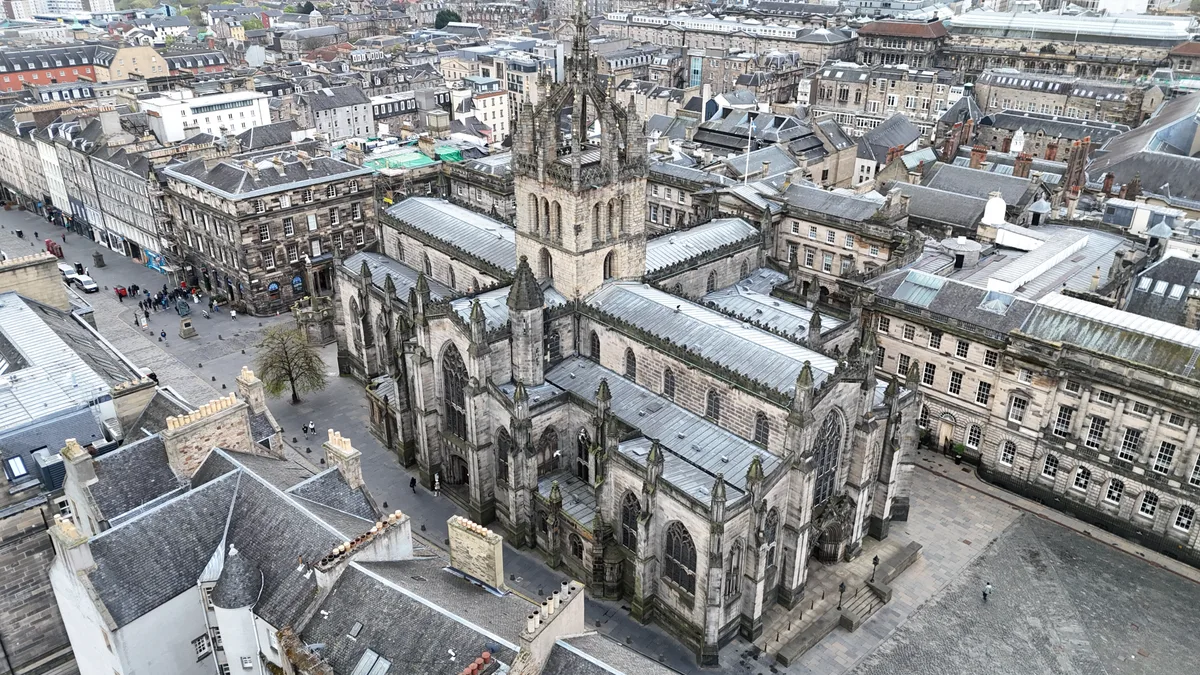
St Giles' Cathedral
Cathedrals · 0.0 km

James Braidwood Statue
Memorials & monuments · 0.0 km

CODE - THE COURT
Hostels · 0.1 km

Mercat Cross
Memorials & monuments · 0.1 km

Signet Library
Historic libraries · 0.1 km

Heart of Midlothian
Cathedrals · 0.1 km

Adam Smith Statue
Memorials & monuments · 0.1 km

Society Of Solicitors' Library, 94-116 Cowgate, Edinburgh
Historic libraries · 0.1 km

Safestay
Hostels · 0.1 km

Fifth Duke of Buccleuch Memorial
Memorials & monuments · 0.1 km
Nearby
📷 4Memorials & monuments · Central Scotland
Charles II of England
Charles II of England — a memorial in scotland-central, United Kingdom.
📷 3Follies · Central Scotland
Grave of John Knox
Grave of John Knox is a folly in the United Kingdom.
★ Iconic📷 5Cathedrals · Central Scotland
St Giles' Cathedral
St Giles' Cathedral — Church of Scotland cathedral in Edinburgh, Scotland, UK.
📷 3Memorials & monuments · Central Scotland
James Braidwood Statue
James Braidwood Statue — a memorial in scotland-central, United Kingdom.
📷 5Hostels · Central Scotland
CODE - THE COURT
CODE - THE COURT — a hostel in scotland central.
📷 4Memorials & monuments · Central Scotland
Mercat Cross
Mercat Cross is a memorial in the United Kingdom.
Where to eat & stay near Equestrian statue of Charles II
Places to stay
📷 5Hostels · Central Scotland
CODE - THE COURT
CODE - THE COURT — a hostel in scotland central.
📷 5 📷 5📷 5
 📷 5
📷 5Hostels · Central Scotland
St Christopher's Inn
St Christopher's Inn — a hostel in scotland central. Brand: St Christopher's Inn.
 📷 5
📷 5Hotels · Central Scotland
Market Street Hotel
Market Street Hotel — a hotel in scotland central.
Places to eat & drink
 📷 5
📷 5Historic pubs · Central Scotland
156-158 High Street, Edinburgh
156-158 High Street, Edinburgh in Scotland Central, United Kingdom.
 📷 5
📷 5Cafés · Central Scotland
Hideout Cafe
Hideout Cafe — a café in scotland central.
 📷 5
📷 5Historic pubs · Central Scotland
Public House, 30, 32, 34 Candlemaker Row, Edinburgh
Public House, 30, 32, 34 Candlemaker Row, Edinburgh in Scotland Central, United Kingdom.
 📷 5
📷 5Restaurants · Central Scotland
The Witchery
The Witchery — a restaurant in scotland central.
 📷 7
📷 7Historic pubs · Central Scotland
3 Drummond Street, Edinburgh
3 Drummond Street, Edinburgh in Scotland Central, United Kingdom.
 📷 7
📷 7Historic pubs · Central Scotland
Oddfellows Hall, 12, 14, 16 Forrest Road, Edinburgh
Oddfellows Hall, 12, 14, 16 Forrest Road, Edinburgh in Scotland Central, United Kingdom.
More places in this region
 📷 3
📷 3Public art & sculpture · Central Scotland
Arboreal
Arboreal — Public artwork (poem) by Richard Livermore.
 📷 3
📷 3Public art & sculpture · Central Scotland
Aspiration
Aspiration — Public artwork (sculpture) by Keith McCarter.
 📷 3
📷 3Public art & sculpture · Central Scotland
Casting
Casting — Public artwork (poem) by Morgan Downie.
 📷 3
📷 3Public art & sculpture · Central Scotland
Deserted Village
Deserted Village — Public artwork (poem) by Anne Connolly.
Frequently asked questions
- Where is Equestrian statue of Charles II?
- Equestrian statue of Charles II is in central Scotland, United Kingdom (postcode EH1 1RE).
- What is Equestrian statue of Charles II?
- Equestrian statue of Charles II in Scotland Central, United Kingdom.
- How do I get to Equestrian statue of Charles II?
- The nearest railway station is Edinburgh Waverley, about 0.3 km away. The nearest town is Edinburgh. Drivers can use postcode EH1 1RE.
- When was Equestrian statue of Charles II built?
- Built or established in 1685.
- Who owns Equestrian statue of Charles II?
- Equestrian statue of Charles II is owned by | accession =.
- Is Equestrian statue of Charles II free to visit?
- Yes, Equestrian statue of Charles II is free to enter.
- How do I get to Equestrian statue of Charles II?
- The nearest railway station is Edinburgh Waverley, about 0.3 km away. Drivers can navigate to postcode EH1 1RE.