
Cathedrals · East of England
Leiston Abbey
In or near Dunwich.
Leiston Abbey is a cathedral in the United Kingdom.

Christopher Hilton — CC BY-SA 2.0 via Wikimedia Commons licence

Plan your visit
- Typical visit
- 1 h–2 h
- Best time of year
- Year-round
- Nearest railway station
- Saxmundham · 6.0 km
- Family-friendly
- Limited wheelchair access
Getting there & planning your visit
To visit Leiston Abbey, the nearest railway station is Saxmundham, located 6 km away. The postcode for sat-nav is IP16 4TD. Accessibility is limited for wheelchair users.
About
Leiston Abbey is a cathedral in england east, United Kingdom — the principal church of its diocese, dating from 1101. Cathedrals are seats of bishops in the Church of England, the Roman Catholic Church, and other Christian denominations across Britain.
Photo gallery
Protected designations
- Area of Outstanding Natural Beauty: Suffolk Coast & Heaths
Designations sourced from Natural England open data under OGL v3.
From the Wikipedia article
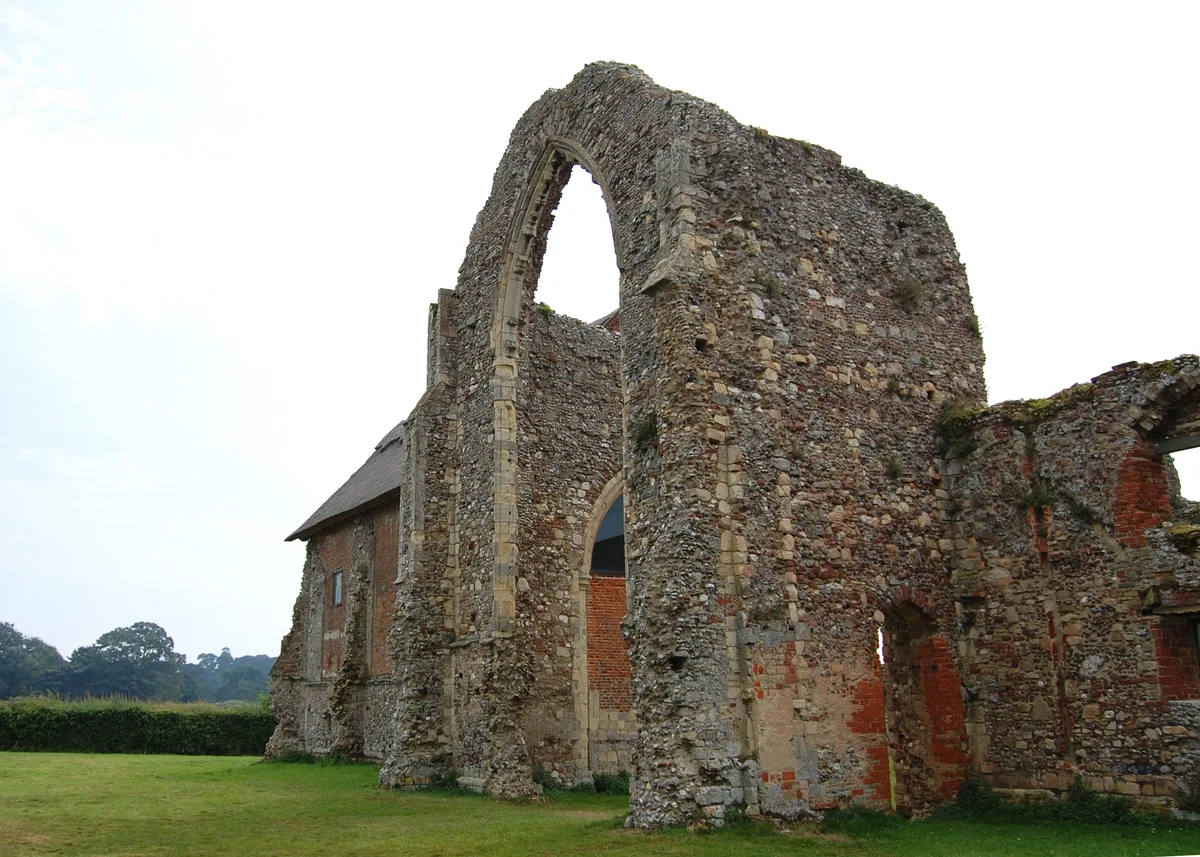
Leiston Abbey outside the town of Leiston, Suffolk, England, was a religious house of Canons Regular following the Premonstratensian rule (White canons), dedicated to St Mary. Founded in c. 1183 by Ranulf de Glanville (c. 1112-1190), Chief Justiciar to King Henry II (1180-1189), it was originally built on a marshland isle near the sea, and was called "St Mary de Insula". Around 1363 the abbey suffered so much from flooding that a new site was chosen and it was rebuilt further inland for its patron, Robert de Ufford, 1st Earl of Suffolk (1298-1369). However, there was a great fire in c. 1379 and further rebuilding was necessary. The house was suppressed in 1537. A Cartulary or monastic register survives. The Abbey's annual rolls of their court of wreck from 1378 to 1481 are a most important historical resource. A series of late visitations, and a list of abbots, are in Premonstratensian records. The impressive remains of the second abbey stand in the fields to the west of the road going north out of Leiston towards Theberton. After the Abbey was closed the estate was granted to Charles Brandon, 1st Duke of Suffolk. The Abbey became a farm, the farmhouse being built into the abbey walls. A Georgian frontage was added to the house, which was extended in the 1920s. In 1928 the ruins and farm were bought by Ellen Wrightson for use as a religious retreat. At her death in 1946 she bequeathed the house, ruins, land and buildings to the Diocese of St Edmundsbury and Ipswich. It was purchased in 1977 to become the home of the Pro Corda Trust, a centre for the specialized education and training of chamber musicians. The site is managed by them, and is in the guardianship of English Heritage.
Excerpt from Wikipedia under CC BY-SA 4.0. See the source article linked in Sources below.
Background
History
Before 1179 (in the presence of Richard de Luci) Henry II granted to Ranulf the manor of Leiston. He sought advice from the abbot of Welbeck Abbey, Nottinghamshire (a Premonstratensian house founded in 1140), who with the king's support visited Prémontré Abbey to obtain permission for Robert, abbot of Durford Abbey near Rogate, Sussex (founded from Welbeck after 1161), to transfer to Ranulf's abbey at Leiston. Robert borrowed canons from both Durford and Welbeck, apparently because Ranulf did not wish Leiston to owe any exaction to a senior house. One of these laid out the site over the course of two months. The manor of Leiston was confirmed to the canons by Pope Lucius III, and royal…
Description
on the Suffolk coast]] Ranulf de Glanville, who was born at Stratford St Andrew, married Bertha, daughter of Theobald de Valoines, Lord of Parham. In 1171 he founded the Priory of Augustinian canons at Butley, a few miles south of Leiston, on lands settled upon his wife by her father as a marriage endowment. The Premonstratensian house of Leiston ("Leystone") Abbey was planned less than a decade later, and a received date for its foundation was 1183. Close ties existed between the two houses, and with the Augustinian nuns at Campsey Priory, a de Valoines foundation established shortly before 1195. The site of the Leiston old abbey is identified with that of a ruined chapel at Minsmere,…
Sourced from Wikipedia under CC BY-SA 4.0.
- Coordinates
- 52.2214, 1.5776
- County
- Suffolk
- District
- East Suffolk
- Parish
- Leiston
- Postcode
- IP16 4TD
- Parliamentary constituency
- Suffolk Coastal
- Established
- 1101
- Nearest railway station
- Saxmundham — 6 km
- Official site
- www.english-heritage.org.uk
Sources
- wikidata: Q6520258 (CC0)
- wikipedia: Leiston Abbey (CC BY-SA 4.0)
Other places nearby
Leiston Abbey
Abbeys & priories · 0.0 km

Theberton House
Historic houses · 1.0 km

Applefields
Campsites · 1.0 km

Cakes and Ale
Caravan parks · 1.2 km

Summerhill School
Natural landmarks · 1.2 km

Richard Garrett & Sons
Museums · 1.5 km

White Horse Hotel
Hotels · 1.5 km

Leiston cum Sizewell Village Sign
Public art & sculpture · 1.5 km
Long Shop Museum
Museums · 1.6 km

Leiston
Museums · 1.7 km

Leiston War Memorial
Public art & sculpture · 1.7 km

Leiston Film Theatre
Theatres · 1.8 km
Nearby
★ Iconic📷 5Abbeys & priories · East of England
Leiston Abbey
Leiston Abbey — abbey in Leiston, East Suffolk, Suffolk, England, UK.
📷 3Historic houses · East of England
Theberton House
Theberton House — house in Theberton, Suffolk, England, UK.
📷 5📷 5📷 5Natural landmarks · East of England
Summerhill School
Summerhill School — a school heritage in england-east, United Kingdom.
📷 5Museums · East of England
Richard Garrett & Sons
Richard Garrett & Sons — a museum in england-east, United Kingdom.
Where to eat & stay near Leiston Abbey
Places to stay
📷 5📷 5📷 5 📷 5
📷 5Caravan parks · East of England
Motorhome & Caravan Club, The Eels Foot
Motorhome & Caravan Club, The Eels Foot — a caravan park in england east.
 📷 5
📷 5Campsites · East of England
Beach View Holiday Park (Formerly Cliff House Park)
Beach View Holiday Park (Formerly Cliff House Park) — a campsite in england east.
 📷 5
📷 5Campsites · East of England
Mill Hill Farm Camping
Mill Hill Farm Camping — a campsite in england east.
Places to eat & drink
 📷 7
📷 7Historic pubs · East of England
The Parrot And Punchbowl Public House
The Parrot And Punchbowl Public House in England East, United Kingdom.
 📷 7
📷 7Historic pubs · East of England
George and Dragon, Farnham
George and Dragon, Farnham in England East, United Kingdom.
 📷 6
📷 6Historic pubs · East of England
The Swan, Peasenhall
The Swan, Peasenhall in England East, United Kingdom.
 📷 7
📷 7Historic pubs · East of England
The Lion, Little Glemham
The Lion, Little Glemham in England East, United Kingdom.
 📷 5
📷 5 📷 5
📷 5Historic pubs · East of England
Huntingfield Arms
Huntingfield Arms in England East, United Kingdom.
More cathedrals in this region
 Flagship📷 5
Cathedrals · East of England
St Albans Market
St Albans Market is a place of interest in the United Kingdom.
 Flagship📷 5
Cathedrals · East of England
Chelmsford Cathedral
Chelmsford Cathedral — a Grade I-listed cathedral in england-london, United Kingdom.
 Flagship📷 5
Cathedrals · East of England
St Albans Cathedral
St Albans Cathedral — a Grade I-listed cathedral in england-london, United Kingdom.
 ★ Iconic📷 4
Cathedrals · East of England
Ely Cathedral
Ship of the Fens — Norman cathedral with a unique octagonal medieval timber lantern.
Frequently asked questions
- Where is Leiston Abbey?
- Leiston Abbey is in Suffolk, East of England, United Kingdom (postcode IP16 4TD), in the parish of Leiston.
- What is Leiston Abbey?
- Leiston Abbey is a cathedral in the United Kingdom.
- How do I get to Leiston Abbey?
- The nearest railway station is Saxmundham, about 6.0 km away. The nearest town is Dunwich. Drivers can use postcode IP16 4TD.
- When was Leiston Abbey built?
- Built or established in 1101.
- Who owns Leiston Abbey?
- Leiston Abbey is owned by English Heritage.
- Is Leiston Abbey a protected site?
- Yes — Leiston Abbey is part of the Suffolk Coast & Heaths National Landscape (AONB).
- How do I get to Leiston Abbey?
- The nearest railway station is Saxmundham, about 6.0 km away. Drivers can navigate to postcode IP16 4TD.