
Memorials & monuments · London
James Clerk Maxwell
In or near Tyburn.
James Clerk Maxwell — a memorial in London, United Kingdom.

Bill Boaden — CC BY-SA 2.0 via Wikimedia Commons licence

Plan your visit
- Typical visit
- 15 min–45 min
- Nearest railway station
- Notting Hill Gate · 0.5 km
- Free entry
- Dog-friendly
Getting there & planning your visit
To visit the James Clerk Maxwell memorial, you can take the train to Notting Hill Gate station, which is 0.5 km away. The memorial has free entry.
About
James Clerk Maxwell is a memorial located in London, United Kingdom. Sourced from OpenStreetMap (ODbL licence); see local listings for visitor information, opening hours and admission details.
Photo gallery
Official information
HJ Art Gallery is an art gallery located in London that showcases a variety of contemporary artworks. Visitors can explore exhibitions featuring both established and emerging artists, as well as participate in events related to the art community.
From the Wikipedia article
James Clerk Maxwell (13 June 1831 – 5 November 1879) was a Scottish physicist and mathematician who was responsible for the classical theory of electromagnetic radiation, which was the first theory to describe electricity, magnetism and light as different manifestations of the same phenomenon. Maxwell's equations for electromagnetism achieved the second great unification in physics, where the first one had been realised by Isaac Newton. Maxwell was also key in the creation of statistical mechanics. Maxwell graduated from Trinity College, Cambridge, in 1854, where he earned distinction in mathematics and the Smith’s Prize. He remained at Cambridge briefly, publishing early mathematical work and investigations into optics, particularly the principles of colour combination and colour-blindness. He later held the Chair of Natural Philosophy at Marischal College in Aberdeen, where he studied the rings of Saturn and correctly proposed that they were composed of numerous small particles, work that earned him the Adams Prize in 1859. During this time he married Katherine Mary Dewar, who assisted him in his laboratory work. From 1860 to 1865, he served as the Professor of Natural Philosophy at King’s College London, where he developed his theory of electromagnetic fields. His publication of "A Dynamical Theory of the Electromagnetic Field" in 1865 demonstrated that electric and magnetic fields travel through space as waves moving at the speed of light, proposing that light is an undulation in the same medium that is the cause of electric and magnetic phenomena. His unification of light and electrical phenomena led to his prediction of the existence of radio waves. Maxwell was the first to derive the Maxwell–Boltzmann distribution, a statistical means of describing aspects of the kinetic theory of gases, which he worked on sporadically throughout his career. He presented the first durable colour photograph in 1861, and showed that any colour can be produced with a mixture of any three primary colours, those being red, green, and blue, the basis for colour television. He worked on analysing the rigidity of rod-and-joint frameworks (trusses) like those in many bridges. He devised modern dimensional analysis and helped to establish the CGS system of measurement. He was the first to recognize chaos, and the first to emphasize the butterfly effect. His 1863 paper On Governors serves as an important foundation for control theory and cybernetics, and was also the earliest mathematical analysis on control systems. In 1867, he proposed the thought experiment known as Maxwell's demon, which challenges how information affects entropy in thermodynamics. In his seminal 1867 paper On the Dynamical Theory of Gases he introduced the Maxwell model for describing the behavior of a viscoelastic material and originated the Maxwell-Cattaneo equation for describing the transport of heat in a medium. In 1871, Maxwell returned to Cambridge as the first Cavendish Professor of Physics, overseeing the construction of the Cavendish Laboratory. As a result of his work he is regarded as a founder of the modern field of electrical engineering. His discoveries helped usher in the era of modern physics, laying the foundations for such fields as relativity, also being the one to introduce the term into physics, and quantum mechanics.
Excerpt from Wikipedia under CC BY-SA 4.0. See the source article linked in Sources below.
- Coordinates
- 51.5058, -0.1919
- District
- Kensington and Chelsea
- Parish
- Kensington and Chelsea, unparished area
- Postcode
- W8 4RP
- Parliamentary constituency
- Kensington and Bayswater
- Phone
- +44 20 7937 7711
- Nearest railway station
- Notting Hill Gate — 0.5 km
- Opening
- Monday 3 – 7 pm; Tuesday to Saturday 11 am – 7 pm; Sunday 11 am – 5 pm; open on Bank Holidays.
Sources
- osm: node/7550480181 (ODbL)
- wikipedia: James Clerk Maxwell (CC BY-SA 4.0)
Other places nearby

10, Palace Green W8
Historic houses · 0.1 km

HAAKON VII
Memorials & monuments · 0.1 km

15, Kensington Palace Gardens
Historic houses · 0.1 km

13 Kensington Palace Gardens
Palaces · 0.2 km

HJ Art Gallery
Galleries · 0.2 km

Frank Bridge
Memorials & monuments · 0.2 km

James Joyce
Memorials & monuments · 0.2 km

Max Beerbohm
Memorials & monuments · 0.2 km

Muzio Clementi
Memorials & monuments · 0.2 km

Edward Henry
Memorials & monuments · 0.2 km
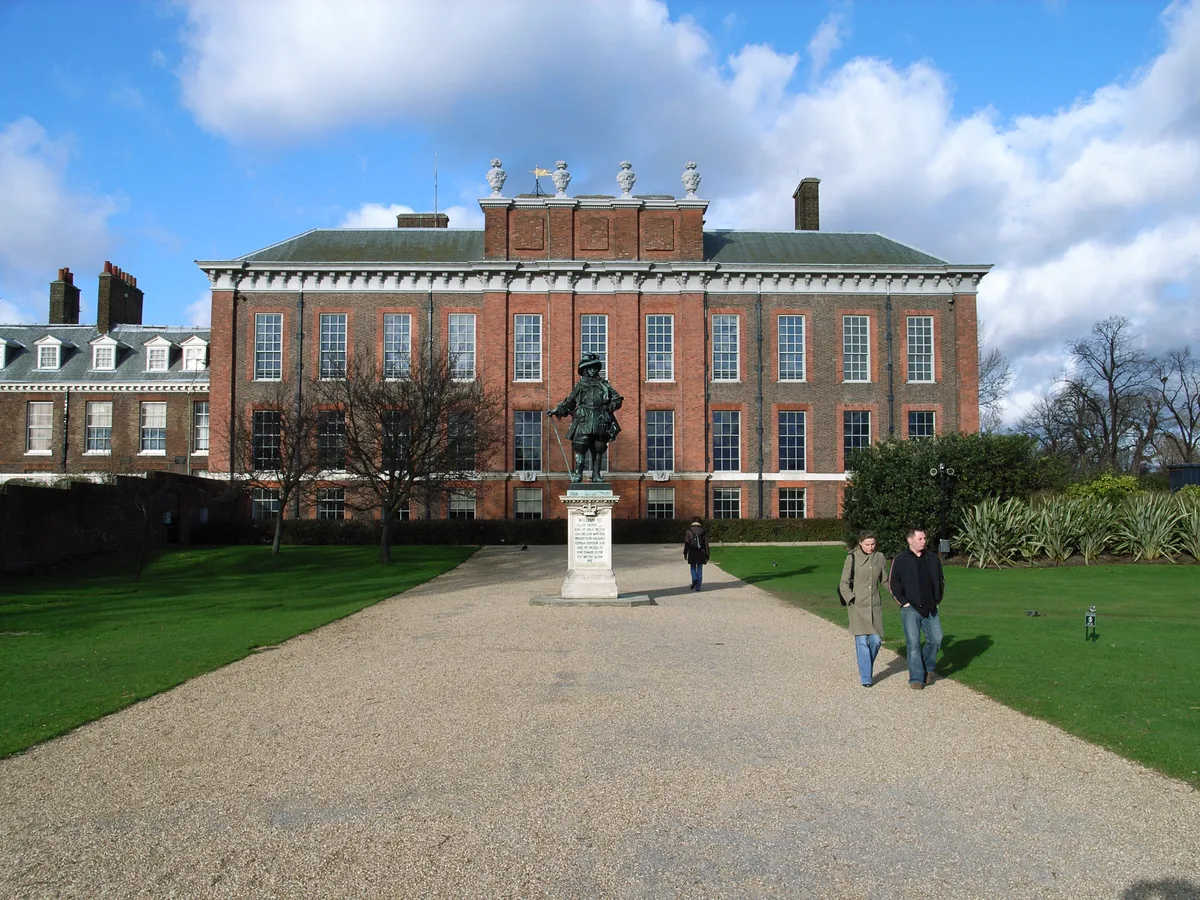
Kensington Palace
Palaces · 0.3 km

Sphinx Fine Art
Galleries · 0.3 km
Nearby
📷 5Historic houses · London
10, Palace Green W8
10, Palace Green W8 — building in Kensington and Chelsea, London, England, UK.
📷 5📷 5Historic houses · London
15, Kensington Palace Gardens
15, Kensington Palace Gardens — house in Royal Borough of Kensington and Chelsea, Greater London, England, UK.
📷 5Palaces · London
13 Kensington Palace Gardens
13 Kensington Palace Gardens — a Grade II-listed palace in england-london, United Kingdom.
📷 5Galleries · London
HJ Art Gallery
HJ Art Gallery — a gallery in London, United Kingdom.
📷 5Memorials & monuments · London
Frank Bridge
Frank Bridge — a memorial in London, United Kingdom.
Where to eat & stay near James Clerk Maxwell
Places to stay
 📷 5
📷 5 📷 5
📷 5 📷 5
📷 5Hotels · London
DoubleTree by Hilton Hotel London - Hyde Park
DoubleTree by Hilton Hotel London - Hyde Park — a hotel in england london. 4-star. Brand: DoubleTree.
 📷 7
📷 7 📷 7
📷 7Hotels · London
Hilton London Hyde Park
Hilton London Hyde Park — a hotel in england london.
 📷 5
📷 5Hotels · London
Kensington House Hotel
Kensington House Hotel — a hotel in england london.
Places to eat & drink
 📷 5
📷 5 📷 7
📷 7Historic pubs · London
Windsor Castle in Kensington
Windsor Castle in Kensington in England London, United Kingdom.
 📷 7
📷 7 📷 5
📷 5Historic pubs · London
Scarsdale Tavern
Scarsdale Tavern in England London, United Kingdom.
 📷 6
📷 6Restaurants · London
Core by Clare Smyth
Core by Clare Smyth — a restaurant in england london.
 📷 5
📷 5More memorials in this region
.jpg?width=1200) 📷 5
📷 5Memorials & monuments · London
1st Surrey Rifles War Memorial
1st Surrey Rifles War Memorial is a memorial in the United Kingdom.
 📷 5
📷 5Memorials & monuments · London
24th East Surrey Division War Memorial
24th East Surrey Division War Memorial is a memorial in the United Kingdom.
 📷 5
📷 5Memorials & monuments · London
Abney Park Cemetery CWGC Cross
Abney Park Cemetery CWGC Cross is a memorial in the United Kingdom.
 📷 5
📷 5Memorials & monuments · London
Admiral Sir John Franklin
Admiral Sir John Franklin is a memorial in the United Kingdom.
Frequently asked questions
- Where is James Clerk Maxwell?
- James Clerk Maxwell is in London, United Kingdom (postcode W8 4RP), in the parish of Kensington and Chelsea, unparished area.
- What is James Clerk Maxwell?
- James Clerk Maxwell — a memorial in London, United Kingdom.
- How do I get to James Clerk Maxwell?
- The nearest railway station is Notting Hill Gate, about 0.5 km away. The nearest town is Tyburn. Drivers can use postcode W8 4RP.
- Is James Clerk Maxwell free to visit?
- Yes, James Clerk Maxwell is free to enter.
- How do I get to James Clerk Maxwell?
- The nearest railway station is Notting Hill Gate, about 0.5 km away. Drivers can navigate to postcode W8 4RP.