
Memorials & monuments · North West England
Hillsborough Stadium Disaster
In or near Liverpool.
Hillsborough Stadium Disaster — a memorial in North West England, United Kingdom.

Philip Halling — CC BY-SA 2.0 via Wikimedia Commons licence

Plan your visit
- Typical visit
- 15 min–45 min
- Nearest railway station
- Liverpool Lime Street · 0.4 km
- Free entry
- Family-friendly
- Dog-friendly
- Wheelchair accessible
Getting there & planning your visit
To visit the Hillsborough Stadium Disaster memorial, you can reach it via Liverpool Lime Street station, which is 0.4 km away. Entry is free, and the site is wheelchair accessible. The postcode for navigation is L3 8EN.
About
Hillsborough Stadium Disaster is a memorial located in North West England, United Kingdom. Sourced from OpenStreetMap (ODbL licence); see local listings for visitor information, opening hours and admission details.
Photo gallery
360° viewimagery from 2022
Imagery © Mapillary contributors, CC BY-SA 4.0
Official information
The World Museum in Liverpool offers a diverse range of exhibits, including displays on natural history, ancient Egypt, and live animals. Visitors can explore interactive experiences such as the planetarium and various themed exhibitions throughout the year.
From the Wikipedia article
The Hillsborough disaster was a fatal crowd crush at a football match at Hillsborough Stadium in Sheffield, South Yorkshire, England, on 15 April 1989. It occurred during an FA Cup semi-final between Liverpool and Nottingham Forest in the two standing-only central pens within the Leppings Lane stand allocated to Liverpool supporters. Shortly before kick-off, police match commander David Duckenfield ordered exit gate C to be opened in an attempt to ease crowding, which led to an influx of supporters entering the pens. This resulted in overcrowding of those pens and the fatal crush; with a total of 97 fatalities and 766 injuries, the disaster is the deadliest in British sporting history. Ninety-four people died on the day; one more died in hospital days later, and two more suffered irreversible brain damage on the day and died in 1993 and 2021 respectively. The match was abandoned and replayed at Old Trafford in Manchester on 7 May 1989; Liverpool won and went on to win that season's FA Cup. In the following days and weeks, South Yorkshire Police (SYP) fed the press false stories suggesting that football hooliganism and drunkenness by Liverpool supporters had caused the disaster. Blaming Liverpool fans persisted even after the Taylor Report of 1990, which found that the main cause was a failure of crowd control by SYP. Following the Taylor Report, the Director of Public Prosecutions ruled there was no evidence to justify prosecution of any individuals or institutions. The disaster led to a number of safety improvements in the largest English football grounds, notably the elimination of fenced standing terraces in favour of all-seater stadiums in the top two tiers of English football. The first coroner's inquests into the Hillsborough disaster, completed in 1991, concluded with verdicts of "accidental death" in respect of all the deceased. Families disputed the findings, and fought to have the case re-opened. In 1997 Lord Justice Stuart-Smith concluded that there was no justification for a new inquiry. Private prosecutions brought by the Hillsborough Family Support Group against Duckenfield and his deputy Bernard Murray failed in 2000. In 2009 a Hillsborough Independent Panel was formed to review the evidence. Reporting in 2012, it confirmed Taylor's 1990 criticisms and revealed details about the extent of police efforts to shift blame onto fans, the role of other emergency services and the errors of the first coroner's inquests. The panel's report resulted in the previous findings of accidental death being quashed, and the creation of new coroner's inquests. It also produced two criminal investigations led by police in 2012: Operation Resolve to look into the causes of the disaster, and by the Independent Police Complaints Commission (IPCC) to examine actions by police in the aftermath. The second coroner's inquests were held from 1 April 2014 to 26 April 2016. They ruled that the supporters were unlawfully killed owing to grossly negligent failures by police and ambulance services to fulfil their duty of care. The inquests also found that the design of the stadium contributed to the crush, and that supporters were not to blame for the dangerous conditions. Public anger over the actions of their force during the second inquests led to the suspension of the SYP chief constable, David Crompton, following the verdict. In June 2017, six people were charged with offences including manslaughter by gross negligence, misconduct in public office…
Excerpt from Wikipedia under CC BY-SA 4.0. See the source article linked in Sources below.
- Coordinates
- 53.4092, -2.9822
- District
- Liverpool
- Parish
- Liverpool, unparished area
- Postcode
- L3 8EN
- Parliamentary constituency
- Liverpool Riverside
- Nearest railway station
- Liverpool Lime Street — 0.4 km
- Opening
- Tuesday to Sunday 10am–5pm; closed Mondays except bank holidays
Sources
- osm: node/12376582901 (ODbL)
- wikipedia: Hillsborough Stadium Disaster (CC BY-SA 4.0)
Other places nearby

T. Major Lester
Memorials & monuments · 0.0 km

St John's Gardens
Parks · 0.0 km

The King’s Liverpool Regiment Monument
Memorials & monuments · 0.0 km
Monument to the King's Liverpool Regiment
Memorials & monuments · 0.1 km

Irish Guards
Memorials & monuments · 0.1 km
British Nuclear Tests Veterans
Memorials & monuments · 0.1 km
Monsignor James Nugent
Memorials & monuments · 0.1 km

World Museum Liverpool
Museums · 0.1 km

Gladstone Monument
Memorials & monuments · 0.1 km

Alexander Balfour
Memorials & monuments · 0.1 km
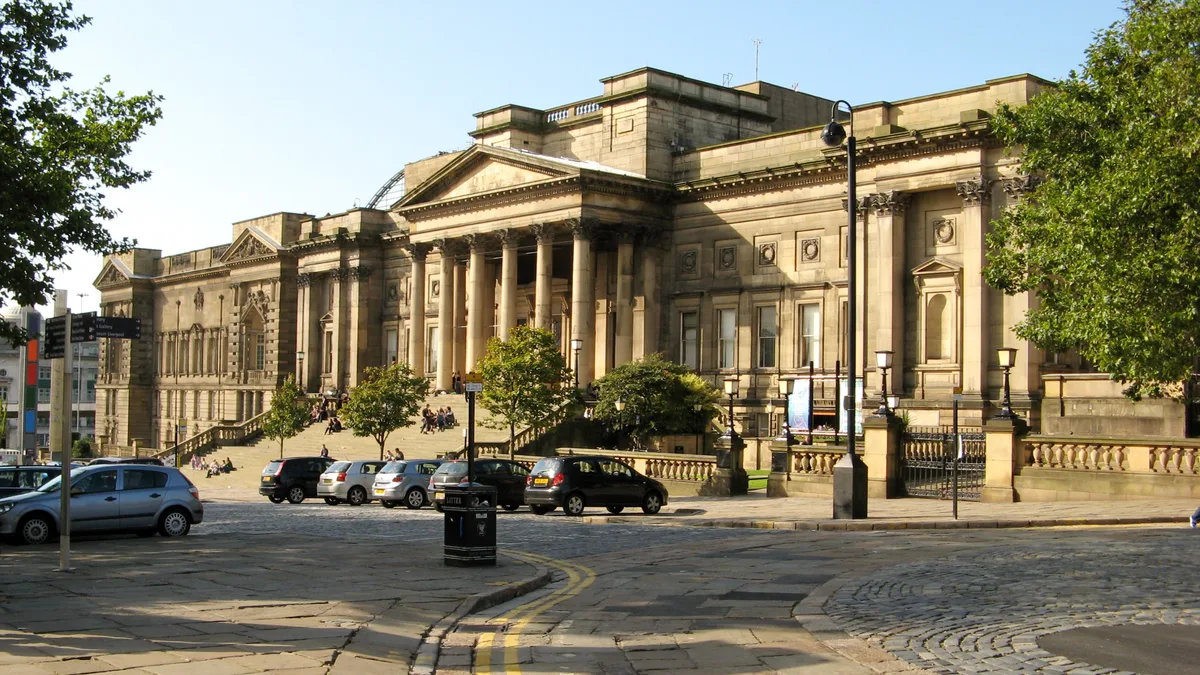
World Museum
Museums · 0.1 km

Rathbone Monument
Memorials & monuments · 0.1 km
Nearby
📷 3Memorials & monuments · North West England
T. Major Lester
T. Major Lester — a memorial in North West England, United Kingdom.
📷 4Parks · North West England
St John's Gardens
St John's Gardens — open space in Liverpool, England.
📷 3Memorials & monuments · North West England
The King’s Liverpool Regiment Monument
The King’s Liverpool Regiment Monument — a memorial in North West England, United Kingdom.
📷 5Memorials & monuments · North West England
Monument to the King's Liverpool Regiment
Monument to the King's Liverpool Regiment — Grade II listed building-listed memorial in wales-north, United Kingdom.
📷 4Memorials & monuments · North West England
Irish Guards
Irish Guards — a memorial in North West England, United Kingdom.
📷 3Memorials & monuments · North West England
British Nuclear Tests Veterans
British Nuclear Tests Veterans — a memorial in North West England, United Kingdom.
Where to eat & stay near Hillsborough Stadium Disaster
Places to stay
 📷 5
📷 5Hotels · North West England
The Shankly Hotel
The Shankly Hotel — a hotel in wales north.
 📷 5
📷 5Hotels · North West England
DoubleTree by Hilton Hotel & Spa Liverpool
DoubleTree by Hilton Hotel & Spa Liverpool — a hotel in wales north. 4-star. Brand: DoubleTree.
 📷 5
📷 5Hostels · North West England
YHA Liverpool Central
YHA Liverpool Central — a hostel in wales north. Brand: Youth Hostels Association.
 📷 5
📷 5Hotels · North West England
Hard Days Night Hotel
Hard Days Night Hotel — a hotel in wales north.
 📷 5
📷 5Hostels · North West England
Monument Building Pierhead Housing
Monument Building Pierhead Housing — a hostel in wales north.
 📷 5
📷 5Places to eat & drink
 📷 5
📷 5Historic pubs · North West England
Crown Hotel
Crown Hotel in Wales North, United Kingdom.
📷 5Historic pubs · North West England
Flanagan's Apple
Flanagan's Apple in Wales North, United Kingdom.
 📷 6
📷 6Historic pubs · North West England
The Vines Public House
The Vines Public House in Wales North, United Kingdom.
 📷 5
📷 5Historic pubs · North West England
Rigby's Buildings
Rigby's Buildings in Wales North, United Kingdom.
 ★ Iconic📷 4
Historic pubs · North West England
The Philharmonic Dining Rooms
Britain's only Grade I-listed pub interior, with the famous marble urinals.
 📷 5
📷 5Restaurants · North West England
Panoramic (restaurant)
Panoramic 34 is a restaurant and bar located on the 34th floor of West Tower, Liverpool. It is 300 feet above ground and claims to be 'one of the UK's highest restaurants' with views as far away as No
More memorials in this region
 📷 3
📷 3Memorials & monuments · North West England
3rd Duke of Bridgewater's monument
3rd Duke of Bridgewater's monument — Monument, dating to 1905.
 📷 3
📷 3Memorials & monuments · North West England
Airborne Forces Memorial
Airborne Forces Memorial is a memorial in the United Kingdom.
 📷 4
📷 4Memorials & monuments · North West England
Albert Memorial
Albert Memorial — Monument, dating to 1869.
 📷 3
📷 3Memorials & monuments · North West England
Armada Beacon
Armada Beacon is a memorial in the United Kingdom.
Frequently asked questions
- Where is Hillsborough Stadium Disaster?
- Hillsborough Stadium Disaster is in North-West England, United Kingdom (postcode L3 8EN), in the parish of Liverpool, unparished area.
- What is Hillsborough Stadium Disaster?
- Hillsborough Stadium Disaster — a memorial in North West England, United Kingdom.
- How do I get to Hillsborough Stadium Disaster?
- The nearest railway station is Liverpool Lime Street, about 0.4 km away. The nearest town is Liverpool. Drivers can use postcode L3 8EN.
- Is Hillsborough Stadium Disaster free to visit?
- Yes, Hillsborough Stadium Disaster is free to enter.
- How do I get to Hillsborough Stadium Disaster?
- The nearest railway station is Liverpool Lime Street, about 0.4 km away. Drivers can navigate to postcode L3 8EN.