
Memorials & monuments · North West England
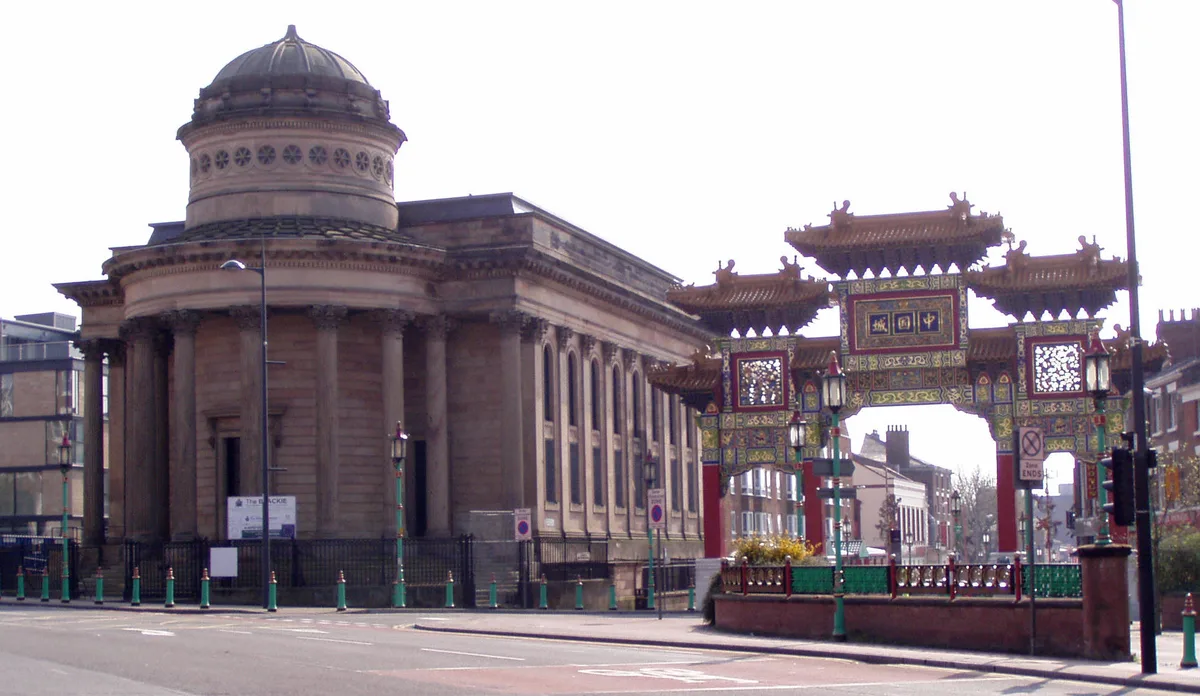
Chinese Arch
Also known as: Ailtireacht na Síne
In or near Liverpool.
Chinese Arch — a memorial in North West England, United Kingdom.

Keith Edkins — CC BY-SA 2.0 via Wikimedia Commons licence

Plan your visit
- Typical visit
- 15 min–45 min
- Nearest railway station
- Liverpool Central · 0.6 km
- Free entry
- Dog-friendly
Getting there & planning your visit
To visit the Chinese Arch, the nearest railway station is Liverpool Central, located 0.6 km away. Entry is free, and the site is accessible to visitors. The postcode for sat-nav is L1 5EW.
About
Chinese Arch is a memorial located in North West England, United Kingdom. Sourced from OpenStreetMap (ODbL licence); see local listings for visitor information, opening hours and admission details.
Photo gallery
360° viewimagery from 2020
Imagery © Mapillary contributors, CC BY-SA 4.0
From the Wikipedia article
Chinese architecture is the embodiment of an architectural style that has developed over millennia in China and has influenced architecture throughout East Asia. Since its emergence during the early ancient era, the structural principles of its architecture have remained largely unchanged. The main changes involved diverse decorative details. Starting with the Tang dynasty, Chinese architecture has had a major influence on the architectural styles of neighbouring East Asian countries such as Japan, Korea, Vietnam, and Mongolia in addition to minor influences on the architecture of Southeast and South Asia including the countries of Malaysia, Singapore, Indonesia, Sri Lanka, Thailand, Laos, Cambodia, and the Philippines. Chinese architecture is characterized by bilateral symmetry, use of enclosed open spaces, feng shui (e.g. directional hierarchies), a horizontal emphasis, and an allusion to various cosmological, mythological or in general symbolic elements. Chinese architecture traditionally classifies structures according to type, ranging from pagodas to palaces. Due to the frequent use of wood, a relatively perishable material, as well as few monumental structures built of more durable materials, much historical knowledge of Chinese architecture derives from surviving miniature models in ceramic and published diagrams and specifications. Although unifying aspects exist, Chinese architecture varies widely based on status or affiliation, such as whether the structures were constructed for emperors, commoners, or for religious purposes. Other variations in Chinese architecture are shown in vernacular styles associated with different geographic regions and different ethnic heritages. The architecture of China is as old as Chinese civilization. From every source of information—literary, graphic, exemplary—there is strong evidence testifying to the fact that the Chinese have always enjoyed an indigenous system of construction that has retained its principal characteristics from prehistoric times to the present day. Over the vast area from Chinese Turkistan to Japan, from Manchuria to the northern half of French Indochina, the same system of construction is prevalent; and this was the area of Chinese cultural influence. That this system of construction could perpetuate itself for more than four thousand years over such a vast territory and still remain a living architecture, retaining its principal characteristics in spite of repeated foreign invasions—military, intellectual, and spiritual—is a phenomenon comparable only to the continuity of the civilization of which it is an integral part. In more recent times, China has become the most rapidly modernizing country in the world. In the past few decades, cities like Shanghai have completely changed their skyline, with some of the world's tallest skyscrapers dotting the horizon. China also has one of the most extensive high speed rail networks, connecting and allowing its large population to travel more efficiently. Throughout the 20th century, Chinese architects have attempted to bring traditional Chinese designs into modern architecture. Moreover, the pressure for urban development throughout China requires high speed construction and a greater floor area ratio: thus, in cities the demand for traditional Chinese buildings (which are normally less than 3 levels) has declined in favor of high-rises. However, the traditional skills of Chinese architecture, including major and minor carpentry,…
Excerpt from Wikipedia under CC BY-SA 4.0. See the source article linked in Sources below.
- Coordinates
- 53.3995, -2.9769
- District
- Liverpool
- Parish
- Liverpool, unparished area
- Postcode
- L1 5EW
- Parliamentary constituency
- Liverpool Riverside
- Nearest railway station
- Liverpool Central — 0.6 km
- Official site
- www.nationaltrust.org.uk
Sources
- osm: way/906629001 (ODbL)
- wikipedia: Chinese architecture (CC BY-SA 4.0)
Other places nearby
Great George Street Congregational Church
Historic churches · 0.0 km

The Whitehouse
Historic pubs · 0.1 km

20-28, Duke's Terrace
Gardens · 0.1 km

Chun Alley
Natural landmarks · 0.2 km
static
Galleries · 0.2 km

The Hardmans' House
Museums · 0.2 km
59 Rodney Street, Liverpool
Museums · 0.2 km

62 Rodney Street, Liverpool
Historic houses · 0.2 km

Picturehouse @ FACT
Theatres · 0.2 km

The Oratory
Natural landmarks · 0.3 km
The Oratory, Liverpool
Historic churches · 0.3 km

Church of St Luke, Liverpool
Historic churches · 0.3 km
Nearby
📷 5Historic churches · North West England
Great George Street Congregational Church
Great George Street Congregational Church — church in Liverpool, Merseyside, England, UK.
📷 7📷 4Gardens · North West England
20-28, Duke's Terrace
20-28, Duke's Terrace — a garden in wales-north, United Kingdom.
📷 3Natural landmarks · North West England
Chun Alley
Chun Alley — a place in North West England, United Kingdom.
📷 3Galleries · North West England
static
static — a gallery in North West England, United Kingdom.
📷 3Museums · North West England
The Hardmans' House
The Hardmans' House — a museum in North West England, United Kingdom.
Where to eat & stay near Chinese Arch
Places to stay
 📷 5
📷 5Hotels · North West England
Hope Street Hotel
Hope Street Hotel — a hotel in wales north.
 📷 5
📷 5Hostels · North West England
International Inn
International Inn — a hostel in wales north.
 📷 5
📷 5 📷 5📷 5
 📷 7
📷 7Hotels · North West England
Maldron Hotel
Maldron Hotel — a hotel in wales north.
Places to eat & drink
📷 7 📷 5
📷 5 📷 5
📷 5Historic pubs · North West England
Philharmonic Dining Rooms
Philharmonic Dining Rooms in Wales North, United Kingdom.
 📷 5
📷 5Historic pubs · North West England
Baltic Fleet
Baltic Fleet — Historic pub — listed building or notable heritage status.
 ★ Iconic📷 4
Historic pubs · North West England
The Philharmonic Dining Rooms
Britain's only Grade I-listed pub interior, with the famous marble urinals.
 📷 5
📷 5Historic pubs · North West England
Grapes Public House And Higsons Brewery
Grapes Public House And Higsons Brewery in Wales North, United Kingdom.
More memorials in this region
 📷 3
📷 3Memorials & monuments · North West England
3rd Duke of Bridgewater's monument
3rd Duke of Bridgewater's monument — Monument, dating to 1905.
 📷 3
📷 3Memorials & monuments · North West England
Airborne Forces Memorial
Airborne Forces Memorial is a memorial in the United Kingdom.
 📷 4
📷 4Memorials & monuments · North West England
Albert Memorial
Albert Memorial — Monument, dating to 1869.
 📷 3
📷 3Memorials & monuments · North West England
Armada Beacon
Armada Beacon is a memorial in the United Kingdom.
Frequently asked questions
- Where is Chinese Arch?
- Chinese Arch is in North-West England, United Kingdom (postcode L1 5EW), in the parish of Liverpool, unparished area.
- What is Chinese Arch?
- Chinese Arch — a memorial in North West England, United Kingdom.
- How do I get to Chinese Arch?
- The nearest railway station is Liverpool Central, about 0.6 km away. The nearest town is Liverpool. Drivers can use postcode L1 5EW.
- Is Chinese Arch free to visit?
- Yes, Chinese Arch is free to enter.
- How do I get to Chinese Arch?
- The nearest railway station is Liverpool Central, about 0.6 km away. Drivers can navigate to postcode L1 5EW.