
Public art & sculpture · North East England
Angel of the North
Also known as: Angel y Gogledd, Aingeal an Tuaiscirt
In or near Felling.
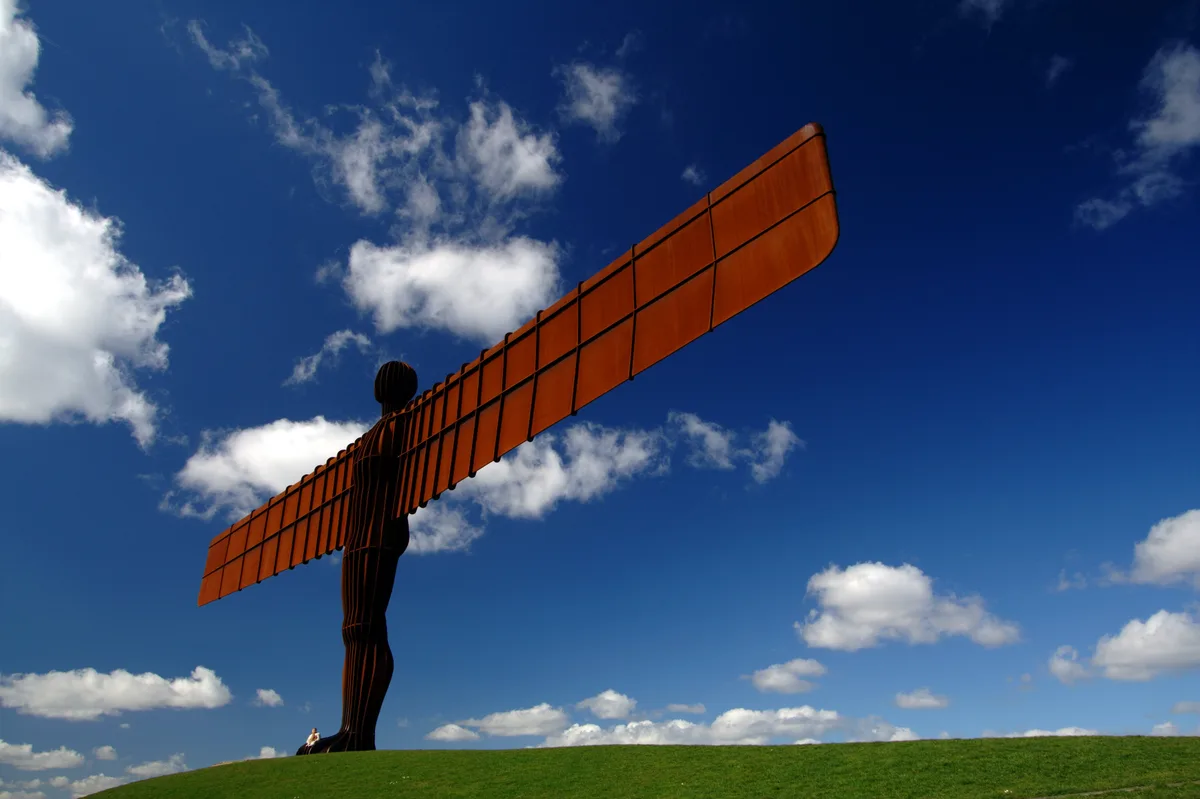
Antony Gormley's iconic 20m steel sculpture above the A1 at Gateshead, since 1998.

Rob Farrow — CC BY-SA 2.0 via Wikimedia Commons licence

Plan your visit
- Typical visit
- 1 h–2 h
- Nearest railway station
- Felling · 4.5 km
- Free entry
- Dog-friendly
- Limited wheelchair access
Getting there & planning your visit
The Angel of the North is located in Gateshead, postcode NE9 7UA, and is accessible via the nearest railway station, Felling, which is 4.5 km away. Entry is free, but wheelchair accessibility is limited.
About
The Angel of the North by Antony Gormley (1998) stands above the A1 at Gateshead — a 20-metre-tall steel sculpture with a 54-metre wingspan, the largest angel sculpture in the world. Unveiled February 1998 as a symbol of the post-industrial north-east. The most-photographed piece of public art in Britain.
Photo gallery
See it from the streetimagery from 2021
Imagery © Mapillary contributors, CC BY-SA 4.0
From the Wikipedia article
The Angel of the North (known locally as Rusty Rita) is a contemporary sculpture by Antony Gormley, located in Gateshead, Tyne and Wear, England. Completed in 1998, it is seen by an estimated 33 million people every year due to its proximity to the A1 and A167 roads and the East Coast Main Line. The design of the Angel, like many of Gormley's works, is based on Gormley's own body. The COR-TEN weathering steel material gives the sculpture its distinctive rusty, oxidised colour. It stands 20 metres (66 ft) tall with a wingspan of 54 metres (177 ft). The vertical ribs on its body and wings act as an external skeleton which direct oncoming wind to the sculpture's foundations, allowing it to withstand wind speeds of over 100 miles per hour (160 km/h). The sculpture was commissioned and delivered by Gateshead Council who approached Gormley to be the sculptor. Although initially reluctant, Gormley agreed to undertake the project after visiting and being inspired by the Angel's proposed site, a former colliery overlooking the varied topography of the Tyne and Wear Lowlands National Character Area. Hartlepool Steel Fabrications were responsible for the manufacture and assembly of the 208-tonne sculpture. On 14 February 1998, the Angel was transported overnight to the installation site and erected the next morning. The project faced opposition during its design and construction, but is now widely recognised as an iconic example of public art and a symbol of Gateshead and the wider North East region.
Excerpt from Wikipedia under CC BY-SA 4.0. See the source article linked in Sources below.
Background
History
sculpture, at Leeds City Art Gallery. The work would have been around 120 ft tall. ]] Prior to the construction of the Angel of the North, Gormley had been in discussion about the creation of a brick sculpture, Brick Man, in Leeds. It would have been around 120 ft tall. The project never came to fruition, although a human-sized maquette (1986) is in Leeds City Art Gallery. At that time, the most significant landmarks that signalled travellers' arrival into Tyneside, when travelling from the south, were the bridges that crossed the River Tyne. In 1990, Gateshead Council first conceived of a sculpture to act as a new landmark for the southern approach into Gateshead and Tyneside, standing…
Architecture
The Angel, like much of Gormley's other work, is based on a cast of his own body. The steel sculpture is 208 tonnes, 20 m tall, with wings measuring 54 m across. Its sheer size and dominance over the surrounding landscape allows for an artistic impact on a large audience. Its wingspan is often compared to that of a Boeing 757 jet, which is actually smaller. It is defined by a rusty, oxidised colour which comes from the COR-TEN weathering steel material which, despite being distinctive, does not contrast harshly with the nearby environment. Inspired by this colour, Gormley had originally intended to call the sculpture The Iron Angel of the North. The wings are angled 3.5 degrees forward to…
Sourced from Wikipedia under CC BY-SA 4.0.
- Coordinates
- 54.9144, -1.5894
- District
- Gateshead
- Parish
- Lamesley
- Postcode
- NE9 7UA
- Parliamentary constituency
- Washington and Gateshead South
- Established
- 1998
- Nearest railway station
- Felling — 4.5 km
Sources
- manual: angel-of-the-north-public-art (manual)
- wikipedia: Angel of the North (CC BY-SA 4.0)
Other places nearby
Angel of the North
Memorials & monuments · 0.0 km

Team Colliery
Mines & mining heritage · 0.3 km

Tyne Yard
Other places · 0.7 km

Lamesley railway station
Heritage railway stations · 0.9 km

Eighton Banks
Other places · 1.1 km

Lamesley
Castles · 1.2 km
Foliate Form
Public art & sculpture · 1.4 km

Eighton Banks War Memorial
Memorials & monuments · 1.6 km

Bowes Incline Hotel
Hotels · 1.6 km

Chowdene
Other places · 1.7 km

North East Green Belt
Other places · 1.7 km

Birtley, Tyne and Wear
Museums · 1.8 km
Nearby
★ Iconic📷 3Memorials & monuments · North East England
Angel of the North
Antony Gormley's 20 m weathered-steel angel above a former colliery.
📷 4Mines & mining heritage · North East England
Team Colliery
Team Colliery in England North East, United Kingdom.
📷 5📷 4Heritage railway stations · North East England
Lamesley railway station
Lamesley railway station in England North East, United Kingdom.
📷 4📷 4Castles · North East England
Lamesley
Lamesley in England North East, United Kingdom.
Where to eat & stay near Angel of the North
Places to stay
📷 5Hotels · North East England
Bowes Incline Hotel
Bowes Incline Hotel — a hotel in scotland lowlands.
 📷 5
📷 5Caravan parks · North East England
Bewicke Main Residential Caravan Park
Bewicke Main Residential Caravan Park — a caravan park in scotland lowlands.
 📷 5
📷 5Caravan parks · North East England
Plum Tree Park
Plum Tree Park — a caravan park in scotland lowlands.
 📷 5
📷 5Caravan parks · North East England
Bobby Shafto Caravan Park
Bobby Shafto Caravan Park — a caravan park in scotland lowlands.
 📷 5
📷 5Hotels · North East England
Rivers Hotel
Rivers Hotel — a hotel in scotland lowlands.
 📷 5
📷 5Hotels · North East England
Hilton Newcastle Gateshead
Hilton Newcastle Gateshead — a hotel in scotland lowlands. 4-star. Brand: Hilton.
Places to eat & drink
 📷 4
📷 4Historic pubs · North East England
Perkinsville
Perkinsville in England North East, United Kingdom.
 📷 5
📷 5Historic pubs · North East England
The Shepherd & Shepherdess
The Shepherd & Shepherdess in Scotland Lowlands, United Kingdom.
 📷 5
📷 5Restaurants · North East England
Stables Bar & Restaurant
Stables Bar & Restaurant — a restaurant in scotland lowlands.
 📷 5
📷 5Restaurants · North East England
House Of Tides
House Of Tides — a restaurant in scotland lowlands.
 📷 5
📷 5Restaurants · North East England
Sambuca
Sambuca — a restaurant in scotland lowlands.
 📷 3
📷 3Historic pubs · North East England
The Crown Posada
Newcastle's Quayside Victorian pub, with William Morris stained glass.
Other works by Antony Gormley
 ★ Iconic📷 5
Public art & sculpture · North West England
Another Place
Antony Gormley's 100 cast-iron figures at Crosby Beach, gazing out to sea since 2007.
★ Iconic📷 3Memorials & monuments · North East England
Angel of the North
Antony Gormley's 20 m weathered-steel angel above a former colliery.
Other places from this era
 📷 5
📷 5Public art & sculpture · London
A Conversation with Oscar Wilde
A Conversation with Oscar Wilde — Public artwork (sculpture).
 📷 5
📷 5Public art & sculpture · London
A Sculpture for Mary Wollstonecraft
A Sculpture for Mary Wollstonecraft — Public artwork (sculpture) by Maggi Hambling.
 📷 5
📷 5Public art & sculpture · London
A Slice of Reality
A Slice of Reality — Public artwork (installation) by Richard Wilson.
.jpg?width=1200) 📷 5
📷 5More places in this region
 📷 3
📷 3Public art & sculpture · North East England
Crossing Points
Crossing Points — a public art in North East England, United Kingdom.
.jpg?width=1200) 📷 3
📷 3Public art & sculpture · North East England
Stockton Flyer
Stockton Flyer — Public artwork (installation).
 📷 3
📷 3Public art & sculpture · North East England
Temenos
Temenos — Public artwork (sculpture) by Anish Kapoor.
 📷 4
📷 4Public art & sculpture · North East England
Apollo Pavilion
Apollo Pavilion in England North East, United Kingdom.
Frequently asked questions
- Where is Angel of the North?
- Angel of the North is in North-East England, United Kingdom (postcode NE9 7UA), in the parish of Lamesley.
- What is Angel of the North?
- Antony Gormley's iconic 20m steel sculpture above the A1 at Gateshead, since 1998.
- How do I get to Angel of the North?
- The nearest railway station is Felling, about 4.5 km away. The nearest town is Felling. Drivers can use postcode NE9 7UA.
- When was Angel of the North built?
- Built or established in 1998. Designed by Antony Gormley.
- Who owns Angel of the North?
- Angel of the North is owned by | operator =.
- Is Angel of the North free to visit?
- Yes, Angel of the North is free to enter.
- How do I get to Angel of the North?
- The nearest railway station is Felling, about 4.5 km away. Drivers can navigate to postcode NE9 7UA.